Long before the digital recording revolution, bands like Uncle Sally had to stand on their own merit. From a time when things were not handed to you on a silver platter, Uncle Sally embodied the very essence of the saying, pull yourself up by your own bootstraps. From 1987 through 1995, the group traversed the Florida club circuit, churning out self-written and produced American made compositions with purpose and dedication, setting themselves apart from their regional counterparts. Along the way, there were no handouts, free lunches, or rich uncles. Uncle Sally’s sound recordings were created before AI, Autotune pitch correction, unlimited digital multi-tracking, or digital home recording studios. Their music is an actual band playing real instruments and singing honest melodies without the fallback position of studio manipulation. Uncle Sally’s entire music catalog was recorded on Ampex 499 2-inch 24 track analog tape and mixed down to quarter inch reel to reel tape, before mastering and distribution. The journey begins here.
In the fall of 1987 Jeff Dyer sought to create an all-original band. He enlisted the help of former Thorndier band vocalist Billy Johnson, drummer Kenny Martinez, bassist JD Paris, and guitarist Doc Lovett, (later known for his work with former Roxx Gang vocalist - Kevin Steele's - The Mojo Gurus). It was on the heels of Guns-n-Roses, Appetite for Destruction that brought about the idea of forming an all original act that would lend itself heavily in blues and groove with an attitude. Dyer, an established solo artist from the Tampa Bay area, had recently earned himself local celebrity status with his music video song, “One Night Stand”, which in 1986, received heavy rotation airplay on Tampa Bay’s 24-hour music television channel V-32. With no inclination to carry the lead vocal duties this time around, Jeff's original intention for his new band was to be the lead guitarist.
Billy Johnson was responsible for bringing the Uncle Sally band name to the table. The name was a knock-off of Aerosmith's “Uncle Salty”, however it also appears to have had some roots in German television, including a play titled "Meet Uncle Sally,” written by Jay Tobias in the 1930s. The name had no other significance or meaning other than it sounded cool and fit the creative vision of Dyer's cigar smoking wolf band logo idea. Airbrush artist (and former Powersurge / Silent Scream drummer) Hal Loo originally drew the patented logo commissioned by Dyer in the early part of 1988.
The new merger of players casually agreed that what comes to the band, stays with the band, regardless of who might stay or go in the band. As Dyer began to introduce new song material, Johnson was summoned to write lyrics for the music. After several weeks with little progress, Billy and the band decided to part ways. He was soon replaced by lead vocalist Tony Wise, who possessed a vocal range that could shatter glass from 20 feet away. Dyer had previously worked with Tony in a heavy metal cover band (Hustler) a few years earlier. With Johnson's departure, the remaining Thorndier boys also began to bow out one by one until only Dyer and Wise were left standing. Although it was a setback, the band name would remain in place moving forward. A nod of recognition goes out to Johnson and Tobias wherever they are.
Several players came and went as Jeff and Tony navigated an endless sea of band-dude-wannabe replacements until guitarist Dave Dennis, bass player Dan Whitman and drummer Marty Kilbel were added. The Dyer/Wise duo wrote 12 songs produced between 1988-1989. Four were professionally recorded and engineered by Allman Brothers Band engineer Bud Snyder at Telstar Studios in Sarasota Florida; becoming the debut Uncle Sally EP titled Loud as Balls. Based on the strength of these recordings, Uncle Sally was chosen by the National Yamaha Sound Check competition to be considered for a major record contract. But when the Yamaha opportunity failed to deliver, Wise became restless with what he felt was a lack of progress. He was also being courted simultaneously by local rival band Tyger Tyger to be their new front man. Tony gave in to the temptation and took the other band offer - permanently ending his tenure with Uncle Sally. If that wasn’t enough drama, incoming drummer Jeff Stahl would also soon replace Marty Kilbel. To complete the new lineup, Jeff Dyer ultimately stepped forward as new lead vocalist and lead guitarist. The now four-piece band once again had a new pulse.

Without missing a beat, the boys pushed forward with guitarist Dave Dennis bringing in a handful of song ideas that would soon become the start of Uncle Sally's second release titled Tending the Flock. Songs like, One-Size-Fits-All, and, That's Not All, helped shape the sound and new direction of Uncle Sally. The sessions were recorded and engineered by Tom Morris at Morrisound Recording Studio in Tampa Florida and released on cassette tape in the summer of 1990. Notable accolades were given for the band's sophomore release, garnering new attention from local radio and club owners. This was the beginning of a new day as the group forged ahead playing live wherever there was an audience. Tampa area clubs like The Rockit Club, Club 19, and ML Chasers, among many others, were all the rage in 1990. The new and improved Uncle Sally would capitalize on every opportunity pushing their agenda forward.
During this era Tampa Bay had established itself as a very original-band-friendly region to play in. Rock radio stations 98ROCK and 95YNF were eager to promote local unsigned artists. Uncle Sally soon became media darlings as the band found themselves in with the in crowd. Local radio DJ legend Austin Keyes (who later went on to become the voice-over for Donald Trump’s celebrity apprentice television show) would soon take Uncle Sally under his wing, giving them ample radio airplay and free promotion - propelling the band forward to be included in many high-profile concert events with well-established national bands - including Dokken, Soundgarden, Saigon Kick, Marilyn Manson, and many others. The local scene did not discriminate against bands based on whether or not they were signed to a major label. This mindset was unheard of in the industry and it single-handedly launched the Tampa Bay music scene to new heights, taking with it bands like Heartless, The Bleeding Hearts, Powersurge, Stranger, St. Warren, Tyger Tyger, UROK and Secret Service.
Riding on the newfound momentum, Uncle Sally returned to the studio in 1991 to work on their third independent release loosely referred to as The Black Album. Obviously, the title reference was familiar to those who followed Metallica, but this was merely a working title due to its black cassette cover. The so-called black album produced ground-breaking songs, Take Me Away from This Evil, and Sail On. Both becoming signature songs played often on 98ROCK and 95YNF. Additional tracks, Borrowed Time, and Times Are Rough, were recorded at Powersound Studio in Clearwater Florida with Frank LaRosa and Bill Lorentsen engineering. The remainder of the tracks were recorded at Morrisound. A multitude of recording sessions were held over this time period bringing to life previously unreleased songs, Living Dangerously, and biker anthem, Come on and Ride. The latter engineered by Doug Johnston at American Music Works in Pinellas Park Florida.
Between 1991-1992 record label contacts were solicited, but still garnered no appreciable outcome for the band. Trying to keep the attention of the A&R guys in New York and LA was like being a pebble of sand in the Florida swampland, woefully out of reach from those who had the power to take the band to its next level. A manager was needed and the band turned to Fred Golpa, owner of the A-circuit Rockit Club. The club of choice for touring rock bands in the southeast. Fred would sign Uncle Sally to a one-year management deal and would assist in landing high profile gigs to help facilitate new record label connections. Sadly, the outcome was not what the band had hoped for as they were mostly put on the back burner by Golpa who was concentrating the majority of his efforts on the club he managed. This circumstance never altered the band's commitment to push forward. They began work on a full-length CD that would soon set them apart from their peers. Recording began at Morrisound in the summer of 1992 with a release date set for early 1993. “World of Hurt” was officially released on February 27th of that year to rave reviews. Local media praised “World of Hurt” for its dynamic production and songwriting quality. You can hear the band's evolution as the lyrical content begins to take on more serious subject matter with a bolder command. It was obvious to anyone paying attention that Uncle Sally was no flash in the pan. The release of “World of Hurt” did set the band apart from the other bands, but success on a national level still remained elusive.

Despite their untenable management deal, the group continued forward by developing fresh material to offer as a follow-up to “World of Hurt”. In the summer of 1993, the band hastily returned to Morrisound yet again to record three additional new tracks - Rain, Escalator, and Made in America. These songs were produced exclusively for a handful of labels expressing interest in the band. One such label was Los Angeles-based Rotten Records, an indie label run by Ron Peterson. In 1994, the band entered into an arrangement with Rotten to facilitate the distribution of Uncle Sally's previously recorded song library. Adding Uncle Sally to the Rotten Records roster would make for strange bedfellows, as the majority of artists signed to Rotten were punk bands such as D.R.I. and Acid Bath. Rotten Records paid for the filming of Uncle Sally's "My Friend Pain" music video to promote the band nationally. But soon again, Uncle Sally found themselves in stagnation with the arrangement and ultimately the Rotten partnership withered on the vine before it ever went to harvest; the deal disintegrated almost as fast as it was initiated. It was the air of uncertainty in the ever-changing music trends that caused the deal to turn sour.
It is important though to put the times in historical context. By the mid 1990’s the music scene had changed fast and furiously. Seattle grunge bands and urban hip-hop acts had pushed the aging rock groups to the sidelines. Uncle Sally could never be accused of being a pretty boy glam band like most of its rock counterparts were, yet they found themselves trapped at a time where it was not in vogue to be associated with anything 1980's, or even early 1990's. The music landscape had shifted. Rock clubs were closing by the hundreds across the country and radio stations began to alter their formats to other styles of music. The hair band era had collapsed like a house of cards, and despite their undeniable talents, Uncle Sally would fall victim to guilt by association, on the bloody sword in the hair-band battlefield.
As the music wave continued to crash, the founder of the group was finding it increasingly difficult to move forward, signaling the end was near for Uncle Sally. In the fall of 1995, Jeff Dyer departed from the band he had helped create. Time and circumstance had taken their toll and Jeff was ready for new beginnings. The tide had turned and it was apparent to Dyer that it was the end of the line. The Uncle Sally curtain had closed. Jeff would however go on to amass nearly 100 studio recordings post Uncle Sally and continues to write and record as a YouTube solo artist to present day. His diverse, extensive body of recorded material can be found at JeffDyer.com.
Fast-forward to 2026, look for Uncle Sally’s newly released full-length digital compilation album titled, Poker on the Table. This 12-song offering captures the remainder of their post-Tony Wise music catalog, including music from Tending the Flock and The Black Album. Also included are a handful of previously unreleased deep cuts including, Rain, Escalator, and a new and improved long-play remastered version of the song, Made in America. This new assortment of Uncle Sally’s finest can be heard on all digital music platforms, including Apple Music, Spotify and YouTube.
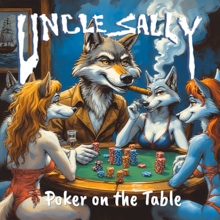
Poker on the Table by Uncle Sally
To date, Uncle Sally has generated a 50+ original song roster with over 30 studio recordings. Look for all four of their official releases available for sale and preview at CD Baby, Apple Music, iTunes, Pandora, YouTube, and Spotify. They have one officially released live album, countless professionally-edited music videos (available on YouTube), accumulated numerous print articles and reviews, had a song featured in the 2016 “Hair I Go Again” music documentary soundtrack, and have appeared on numerous radio, television and concert stages. To this day Uncle Sally continues to maintain a solid footing in the foundation of America’s Rock-n-Roll historical ledger.

Uncle Sally is:
Jeff Dyer:
Lead vocals / Lead guitars
Dave Dennis:
Guitars / Slide guitar / backup vocals.
Dan Whitman:
Bass guitar / backup vocals.
Jeff Stahl:
Drums
Extra special thanks to our dedicated Road Crew for their hard work and commitment to the cause over the years. We could not have done it without you.
Andrew Gaylord -
Stage manager / lighting
Gerald Mullen -
Road crew manager
Nathan Keefer -
Drum Tech
Randy Hall -
Guitars / Stage tech
Frances Beck Hamlett, Gina Crawford and Molly Friar-
Merchandise and promotion
Additional thanks to:
Billy Johnson
Austin Keyes
Mike Norcia
Kim Martino
Mike Calta
Bobby Lane
And ALL the fans!
Special thanks to the Rock Duck Mark Christopher Garrett for creating the new digital album cover, Poker on the Table.
Music produced by Uncle Sally
Correspondence: unclesally@jeffdyer.com
GangWolf Records
Protected by U.S. Copyrights
All Rights Reserved

All Rights Reserved

